
Every Rolex has a short code that tells you exactly what it is: the model, the generation, the metal and often the bezel colour. Learn to read it and a listing like “126610LV” stops being jargon and becomes a full description of the watch.
This guide walks through how the code is built, with real examples, so you can check that the watch in front of you matches the one you were promised.
Reference number vs. serial number
A Rolex carries two different numbers, and they do different jobs.
| Reference number | Serial number | |
|---|---|---|
| What it identifies | The model. Every watch of that model shares it | That one individual watch |
| Example | 126610LV | A unique code of letters and digits |
| Where to find it | Engraved between the lugs at 12 o’clock, and printed on the warranty card | Engraved on the inner ring of the dial (the rehaut) at 6 o’clock on modern pieces, and on the warranty card |
| Should a seller share it? | Yes, it belongs in every listing | Usually only with a serious buyer, as part of verification |
The reference tells you what the watch is. The serial helps prove which watch it is. This article is about the reference.
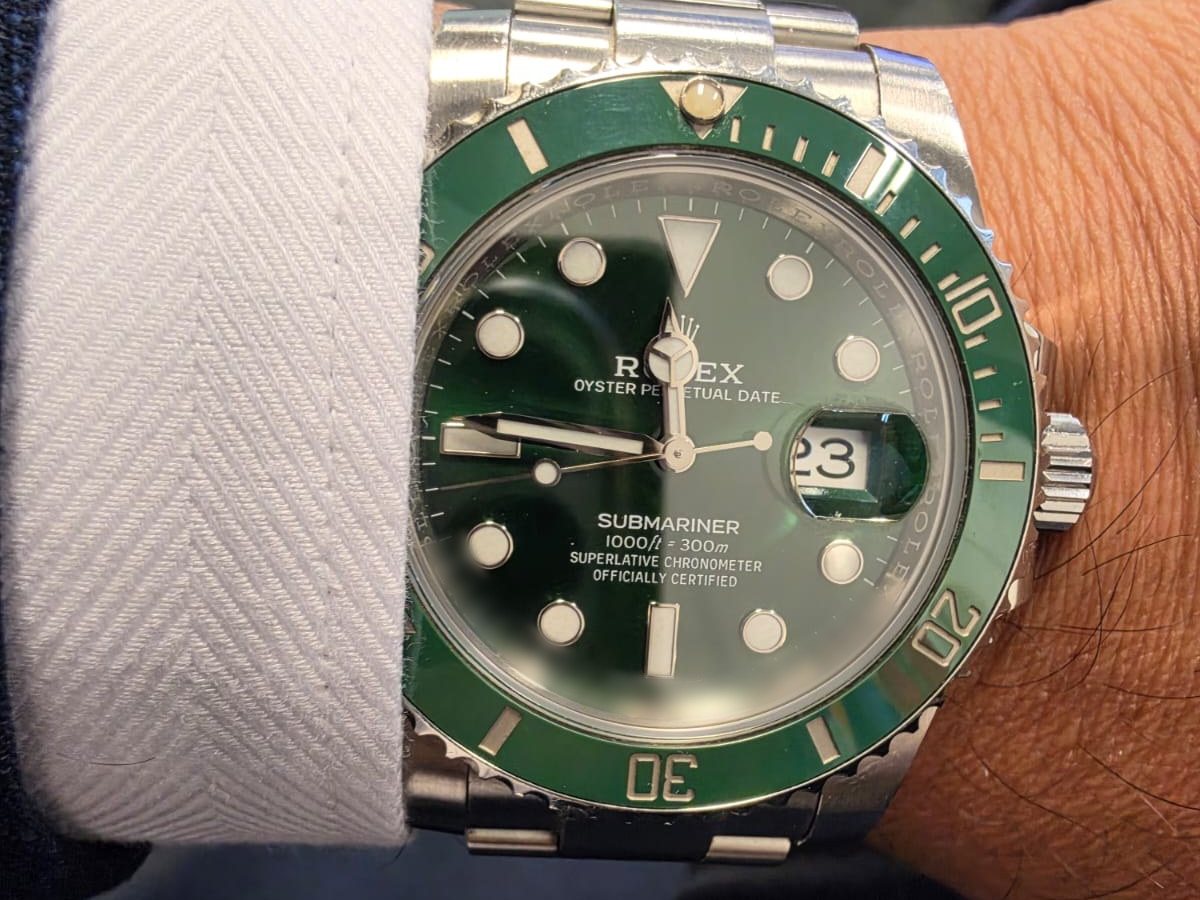
Pictured above: a Submariner Date ref. 116610LV, the "Hulk". The serial on the inner dial ring has been blurred, which is standard practice when a watch is photographed for sale.
Reading a modern reference, piece by piece
Most current Rolex references have six digits, sometimes followed by letters. Read from left to right, they go from the general (which generation, which model) to the specific (which metal, which bezel).
126610LV: a current steel Submariner Date with a green bezel
11 = previous
(GMT-Master II is 671)
8 = yellow gold
Lunette Verte
The highlighted digit, the material, is the one to learn first. The next two sections cover it and the letters in full.
The last digit: what it’s made of
On a modern six-digit reference, the final number tells you the case metal. It is the quickest way to tell a steel watch from a gold or platinum one.
| Last digit | Material | Example |
|---|---|---|
| 0 | Oystersteel (stainless steel) | 126610LN, Submariner Date |
| 1 | Everose Rolesor (steel and 18k Everose gold) | 126711CHNR, GMT-Master II “Root Beer” |
| 2 | Rolesium (steel and platinum) | 126622, Yacht-Master 40 |
| 3 | Yellow Rolesor (steel and 18k yellow gold) | 126613LB, Submariner Date |
| 4 | White Rolesor (steel and 18k white gold) | 126334, Datejust 41 |
| 5 | 18k Everose gold | 126515LN, Daytona |
| 6 | Platinum | 126506, Daytona |
| 8 | 18k yellow gold | 126618LN, Submariner Date |
| 9 | 18k white gold | 126619LB, Submariner Date |
“Rolesor” is Rolex’s name for steel and gold on the same watch, often called “two-tone”. On White Rolesor, the gold is usually only the bezel, so the watch can look all-steel at first glance. On vintage five-digit references, a few of these digits had slightly different meanings, so treat this table as a guide to modern pieces.
The letters: bezel colour and gem-setting
Letters after the digits mostly describe the bezel. They come from French abbreviations, which is why they don’t always match the English colour name.
| Suffix | Stands for | What you’ll see | Example |
|---|---|---|---|
| LN | Lunette Noire | Black bezel | 126610LN, Submariner Date |
| LV | Lunette Verte | Green bezel | 126610LV, Submariner Date |
| LB | Lunette Bleue | Blue bezel | 126619LB, Submariner Date |
| BLRO | Bleu / Rouge | Blue and red bezel (“Pepsi”) | 126710BLRO, GMT-Master II |
| BLNR | Bleu / Noir | Blue and black bezel (“Batman”) | 126710BLNR, GMT-Master II |
| CHNR | Chocolat / Noir | Brown and black bezel (“Root Beer”) | 126711CHNR, GMT-Master II |
| VTNR | Vert / Noir | Green and black bezel (“Sprite”) | 126720VTNR, GMT-Master II |
| GRNR | Gris / Noir | Grey and black bezel | 126713GRNR, GMT-Master II |
| RBR | Factory gem-setting | Diamonds set by Rolex, typically on the bezel | 128348RBR, Day-Date 36 |
You may also see a short code after a dash, such as 116610LV-0002. That is Rolex’s catalogue number for one exact version of the model, down to the dial and bracelet. Two watches with the same reference can have different dials, and this code tells them apart.
How references change between generations
When Rolex updates a model, it usually keeps the core of the reference and changes the digits in front. That makes it easy to spot which generation a watch belongs to, even when two look almost identical in photos.
Four generations of the Submariner Date, one reference each
-
1680
Late 1960s on
Acrylic crystal -
16610
c. 1988 to 2010
Aluminium bezel -
116610
2010 to 2020
Ceramic bezel -
126610
2020 to today
Larger 41mm case
The same pattern runs across the catalogue: the GMT-Master II went from 116710 to 126710 in 2018, and the Daytona from 116500 to 126500 in 2023. Older watches with four or five digits follow their own conventions, so for vintage pieces it is worth asking a specialist.
Five references, decoded
Put the pieces together and each reference reads like a sentence.
| Reference | Breakdown | In plain English |
|---|---|---|
| 126610LN | 12 · 661 · 0 · LN | Current generation, Submariner Date, steel, black bezel |
| 116610LV | 11 · 661 · 0 · LV | Previous generation, Submariner Date, steel, green bezel: the “Hulk” |
| 126710BLRO | 12 · 671 · 0 · BLRO | Current generation, GMT-Master II, steel, blue and red bezel: the “Pepsi” |
| 126334 | 12 · 633 · 4 | Current generation, Datejust 41, White Rolesor with a fluted white gold bezel |
| 126506 | 12 · 650 · 6 | Current generation, Daytona, platinum |
One caution: model families don’t all split their digits the same way, so read the reference as a whole rather than forcing every number into a box. The material digit and the letters are the reliable parts. On dress models such as the Datejust, the second-to-last digit often signals the bezel style: 126300 has a smooth steel bezel, while 126334 has a fluted one.
Using the reference when you buy
The reference number is your first check that a listing is what it claims to be. Before you commit to any pre-owned Rolex:
- Match the reference on the listing to the warranty card. The model, metal and bezel should all agree.
- Match it to the watch itself. Ask to see the engraving between the lugs at 12 o’clock.
- Check the details against the code. A reference ending in 0 should be a steel watch; one ending in 8 should be solid yellow gold. If the bezel colour doesn’t fit the suffix, ask why.
- Compare prices like for like. A 116610LV and a 126610LV look alike in photos but are different generations, and they are priced differently.
- Ask about box and papers. A matching warranty card is one of the strongest supporting signals of a watch’s history.
A reference that matches is a good start, not the whole story. Movement, dial and case condition still need an expert eye, which is why every watch we sell goes through our verification process.
Looking for a specific reference? Send us the number and our team in the U.A.E. will help you find it.
Enquire on WhatsApp